
Reading Tarot Holistically: Letting the Cards Speak to Each Other
We had such a fun event at Lake City Books this week during my Introduction to Tarot workshop. One of the core ideas we focus on in class is moving beyond memorizing card definitions and instead learning how to use intuition, instinct, and visual storytelling to create a coherent, meaningful reading.
Tarot doesn’t live in isolated meanings. It lives in relationships.
During the workshop, one of the learners pulled three cards in a simple three-card spread. (We were reading for my kids’ stuffed animals, which added an extra layer of delight.) The spread we were practicing, read left to right, was:
- Something from the past to leave behind
- A theme for the current moment
- Wisdom for the future
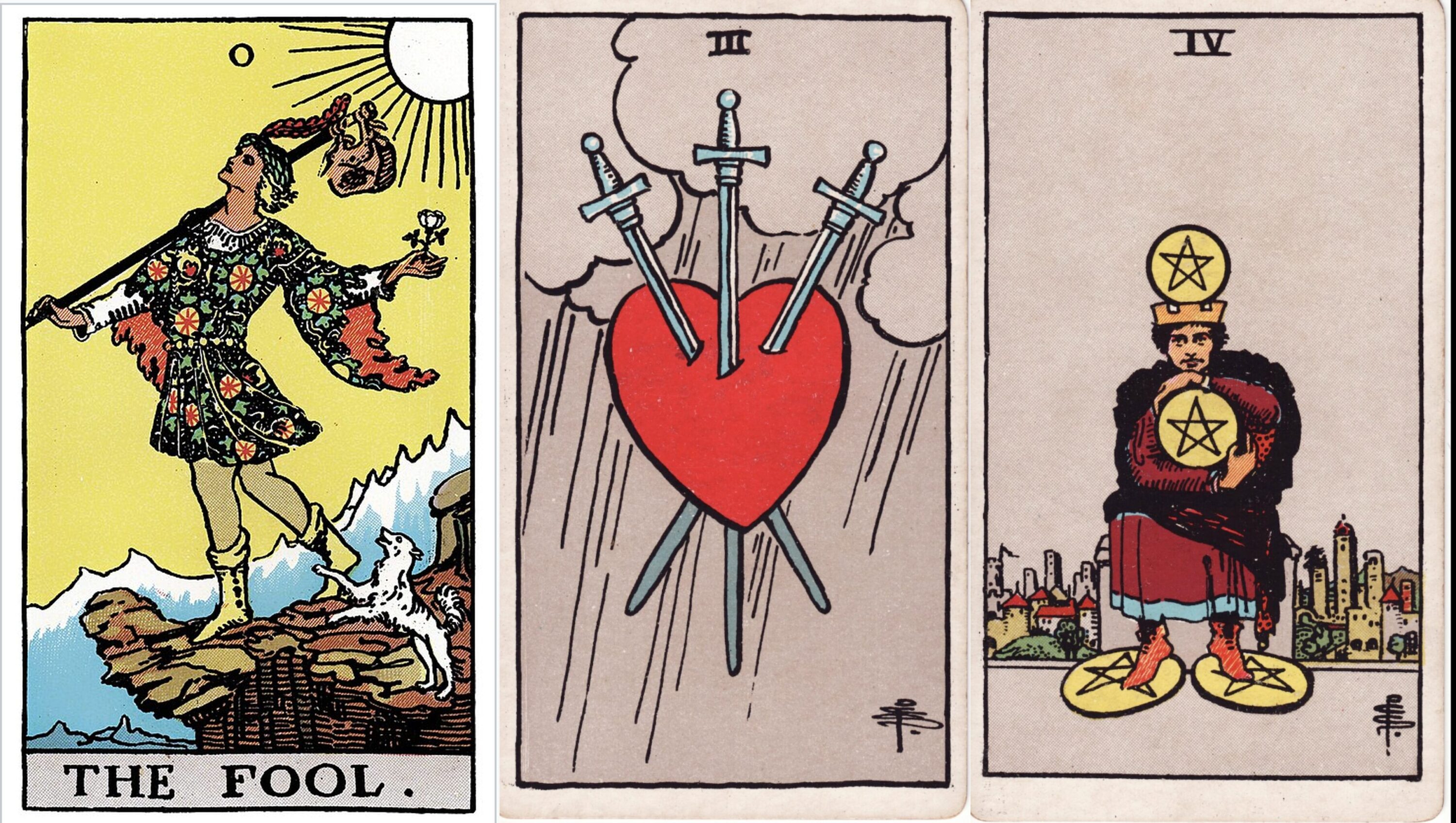
The cards drawn were The Fool, Three of Swords, and Four of Pentacles.
The learner already had a solid grasp of the traditional meanings:
The Fool as new beginnings, openness, and trust.
The Three of Swords as heartbreak or emotional pain.
The Four of Pentacles as guarding resources, holding tightly, or self-protection.
But she paused and asked a great question: How do I make sense of these as a full reading, rather than three separate ideas?
That question is where tarot really begins.
I encouraged her to step back and look at the energy of the images and the way the cards were speaking to each other. This is one of the great strengths of the Rider–Waite–Smith deck: its symbolism is intentional, layered, and deeply relational. The cards are designed to converse.
We started by comparing the two figures that frame the spread: The Fool on the left and the Four of Pentacles on the right.
The Fool is completely open. His posture is expansive, his chest is forward, his heart chakra fully exposed. He embodies that naïve, trusting energy we often love in The Fool—hopeful, unguarded, and willing to leap.
The Four of Pentacles—sometimes called the miser of the deck—is the opposite. The figure is closed in on themselves, physically and energetically. A pentacle is pressed tightly against the heart. Another crowns the head. Two more pin the feet in place. This is a posture of protection, control, and self-containment.
When you place these two cards on either side of the Three of Swords, the story sharpens immediately.
The message becomes clear:
You were too open, too naïve, too exposed—and it hurt you. Deeply.
The heartbreak didn’t come out of nowhere. It came from vulnerability without boundaries.
Seen this way, the wisdom of the spread isn’t cynical or punitive. It’s compassionate. The tarot isn’t saying “never be open again.” It’s saying: be intentional about your boundaries. Protect what is truly valuable. Give yourself time to heal.
Because the Four of Pentacles is a minor arcana card, I would read this not as a permanent spiritual stance, but as a necessary phase. A stage of consolidation and self-protection before deciding what comes next. The tarot suggests that this kind of guardedness is appropriate for now—a step in the process, not the final destination.
This is what it means to read tarot holistically. The cards don’t just tell you what happened or what might happen. They show you how the story unfolds, where the tension lives, and what kind of wisdom is being asked of you in this moment.
And sometimes, even when reading for a stuffed animal, the message lands exactly where it needs to.
Published on Jan 17 2026
Categories: Weekly Tarot Reading